

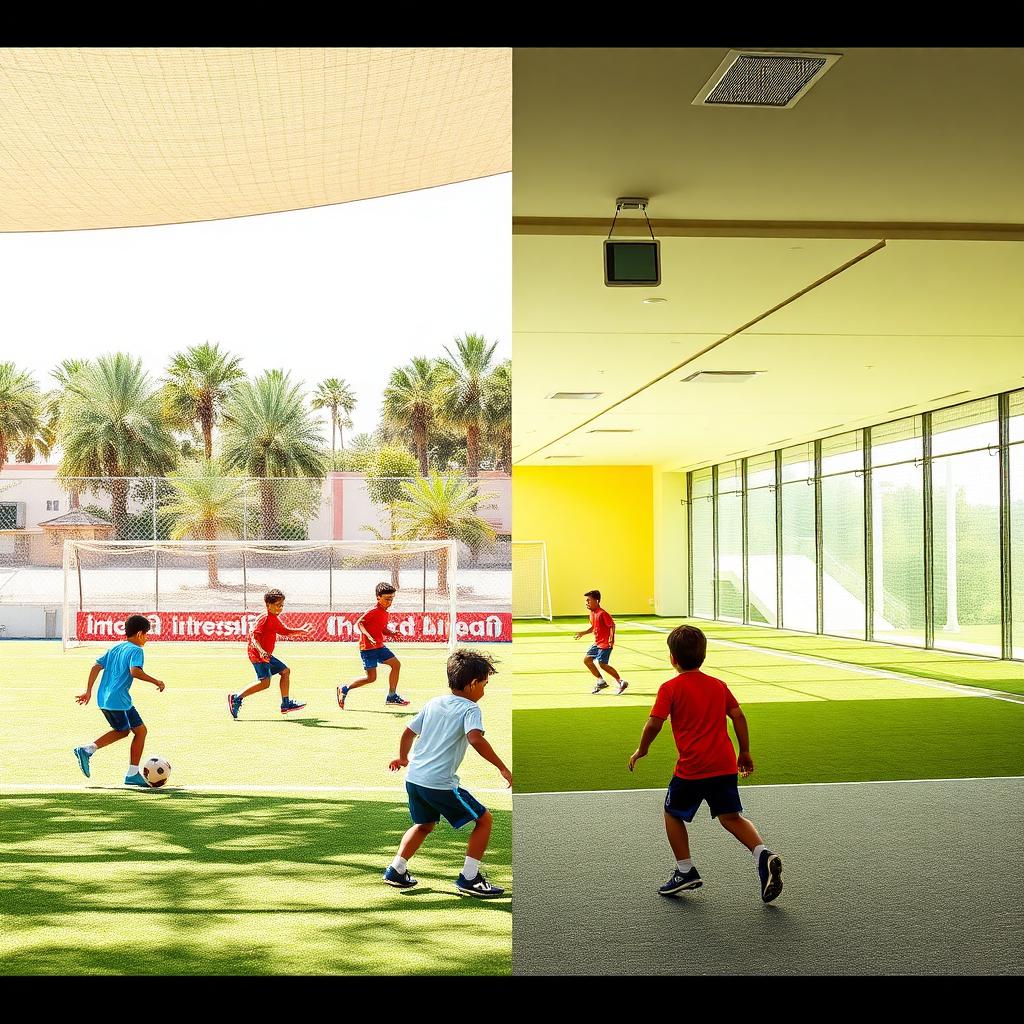
Dubai summers make outdoor youth football genuinely difficult. From late May to mid-September, afternoon temperatures regularly hit 42–45°C with humidity above 60%. Kids overheat fast, hydration alone doesn't fix it, and even shaded pitches struggle by 5pm. This is a practical guide for parents on what a well-run academy does during those four months — and how to keep your child training safely without taking the summer off.
When outdoor sessions still work
Early morning weekend sessions (7–9am) are the outdoor sweet spot through June and July. Pitches are still cool from the night, humidity is lower than mid-afternoon, and there's no direct sun overhead. By August, even these become borderline. Evening sessions after 7pm can work in early June and late September but not through peak summer.
Why indoor is essential from June to August
Air-conditioned indoor pitches — properly cooled to 22–25°C, not just under a roof — are the only reliable way to run afternoon and evening training through peak summer. The difference from a shaded outdoor pitch is enormous: kids can train at full intensity for 60–90 minutes without the fatigue and dehydration that a hot outdoor session guarantees.
The catch: not all 'indoor' facilities in Dubai are truly air-conditioned. Some are covered but not cooled, which is barely better than the outdoors. Ask specifically: is the pitch air-conditioned to a set temperature? At EPIC, indoor sessions run at Dwight School Dubai's fully climate-controlled pitches through the summer.
What a good academy adjusts in summer
- Shorter warm-ups and more water breaks — typically every 12–15 minutes rather than 20–25.
- Lower-intensity technical work, not high-tempo conditioning.
- Compulsory water bottles at every session and monitoring for early signs of heat stress.
- Session cancellation policies when the outdoor UV index or heat index crosses a defined threshold.
- Kit adjustments — lighter fabrics, moisture-wicking, no dark colours for outdoor.
A well-run academy has these written down and rehearsed. Ask what their heat policy is — a vague answer is a red flag.
The retention argument
Parents often pull their kids from training for the whole summer and restart in September. The kids who train through summer come back sharper, fitter, and ahead of the ones who took four months off. It's the single biggest development gap in the Dubai youth football calendar. Indoor sessions once or twice a week through summer are enough to close it.
Summer camps vs regular training
Summer camps (usually week-long intensives) are great for a specific week when a family isn't travelling. They don't replace regular weekly training for continuous development — the gaps between camps still lose fitness and skill. If you can only do one or the other through July, weekly indoor training beats a one-off camp.
What to look for in a summer programme
- Genuinely air-conditioned indoor pitches (confirm the temperature, not just the roof).
- A written heat policy and clear session-cancellation triggers for outdoor slots.
- Coaches trained to recognise early heat stress in children.
- Flexible booking — many families travel in July and August, and a good academy accommodates that.
- Continuous programming rather than a hard break, so returning players don't reset every August.
The honest verdict
Football in Dubai summer is safest and most productive indoors. Weekend outdoor sessions early in the morning are a reasonable supplement in June and September, but for the peak eight to ten weeks, indoor is the only reliable option. Any academy that doesn't offer it isn't a summer academy — they're a winter academy on pause.